How God Loves
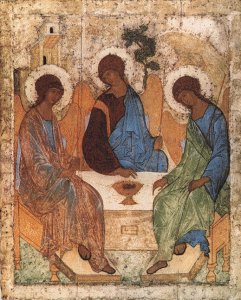
We often begin Mass with the prayer from today’s Epistle: “The grace of the Lord Jesus Christ, and the love of God, and the fellowship of the Holy Spirit be with all of you.” We praise the God who has revealed himself as a Trinity, a communion of persons.
Communion with the Trinity is the goal of our worship – and the purpose of the salvation history that begins in the Bible and continues in the Eucharist and sacraments of the Church.
We see the beginnings of God’s self-revelation in today’s First Reading, as He passes before Moses and cries out His holy name.
Israel had sinned in worshipping the golden calf (see Exodus 32). But God does not condemn them to perish. Instead He proclaims His mercy and faithfulness to His covenant.
God loved Israel as His firstborn son among the nations (see Exodus 4:22). Through Israel – heirs of His covenant with Abraham – God planned to reveal himself as the Father of all nations (see Genesis 22:18).
The memory of God’s covenant testing of Abraham – and Abraham’s faithful obedience – lies behind today’s Gospel.
In commanding Abraham to offer his only beloved son (see Genesis 22:2,12,16), God was preparing us for the fullest possible revelation of His love for the world.
As Abraham was willing to offer Isaac, God did not spare His own Son but handed Him over for us all (see Romans 8:32).
In this, He revealed what was only disclosed partially to Moses – that His kindness continues for a thousand generations, that He forgives our sin, and takes us back as His very own people (see Deuteronomy 4:20; 9:29).
Jesus humbled himself to die in obedience to God’s will. And for this, the Spirit of God raised Him from the dead (see Romans 8:11), and gave Him a name above every name (see Philippians 2:8-10).
This is the name we glorify in today’s Responsorial – the name of our Lord, the God who is Love (see 1 John 4;8,16).
St. Athanasius
Letters to Serapion, 1, 19 (PG 26, 373)
Fools!…, how is it that you can’t stop your prying investigations into the Trinity or be content to believe it exists since you have for your guide the apostle who wrote: “Anyone who approaches God must believe that he exists and that he rewards those who seek him” (Heb 11,6)… So let no one put unnecessary questions to himself but be content with learning what is contained in Scripture…
Scripture tells us that the Father is both source and light: “They have forsaken me, the source of living waters” (Jer 2,13); “You have forsaken the fountain of wisdom” (Ba 3,12) and, according to John, “God is light” (1Jn 1,5). Now the Son is called a river in relation to the source for, according to the psalm, “the river of God is full of water” (Ps 65[64],10). And in relation to the light he is called splendor when Paul says that he is “the refulgence of his glory and the very imprint of his being” (Heb 1,3).
Thus the Father is light, the Son its refulgence… and, in the Son, it is by the Spirit that we are illuminated. “May God give you a spirit of wisdom and revelation,” says Paul, “resulting in knowledge of him. May the eyes of your hearts be enlightened” (Eph 1,17-18). But when we are enlightened it is Christ who enlightens us in him, for Scripture says: “He was the true light who enlightens everyone coming into the world” (Jn 1,9).
Moreover, since the Father is source and the Son is called river we are said to drink of the Spirit: “We were all given to drink of one Spirit” (1Cor 12,13). But, refreshed by the Spirit, we drink Christ since: “They drank from a spiritual rock that followed them, and the rock was the Christ” (1Cor 10,4)…
God alone is wise and the Son his wisdom, for “Christ is the power and the wisdom of God” (Rm 16,27;1Cor 1,24). So it is in receiving the Spirit of wisdom that we possess the Son and gain wisdom in him… The Son is life.
He said: “I am the Life” (Jn 14,6). But it is said that we are brought to life by the Spirit, as Paul wrote: “The one who raised Christ from the dead will give life to our mortal bodies also through his Spirit that dwells in us” (Rm 8,11). But when we have been brought to life by the Spirit then Christ will be our life… “I live, no longer I, but Christ lives in me” (Gal 2,20).
When such a correspondence and unity exists in the Holy Trinity, who can separate either the Son from the Father or the Spirit from the Son or the Father?… God’s mystery is not communicated to our minds by demonstrative arguments but in faith and reverent prayer.
Pope Benedict XVI
Angelus Address, May 22, 2005
Today, the liturgy celebrates the Solemnity of the Most Holy Trinity almost to underline that in the light of the Pascal Mystery is fully revealed the centre of the universe and of history: God himself, eternal and infinite Love. The word that summarizes all revelation is this: “God is love” (I Jn 4: 8, 16); and love is always a mystery, a reality that surpasses reason without contradicting it, and more than that, exalts its possibilities.
Jesus revealed to us the mystery of God: he, the Son, made us know the Father who is in Heaven, and gave us the Holy Spirit, the Love of the Father and of the Son. Christian theology synthesizes the truth of God with this expression: only one substance in three persons. God is not solitude, but perfect communion. For this reason the human person, the image of God, realizes himself or herself in love, which is a sincere gift of self.
We are contemplating the mystery of the love of God shared in a sublime way in the Most Holy Eucharist, the Sacrament of the Body and Blood of Christ, the representation of his redeeming Sacrifice.
Saint Ephrem
Hymn on the Trinity
Refrain: Blessed be the One who sends you!
Take as your symbols: the sun for the Father,
light for the Son,
heat for the Holy Spirit.
Though he is only one in being
we see him in trinity.
Who, indeed, can grasp the inexplicable?
He who is unique is also multiple: one is formed of three
and three of one –
What great mystery! What manifest wonder!
The sun is distinct from its shining
even while adhering to it,
for its ray is also sun.
Yet no one speaks of two suns
even though, here below,
the sun’s ray is also sun.
No more do we say there would be two Gods.
Our Lord himself, is he not God?
He is also raised above all creatures.
Who can show how or where
the sun’s ray and its heat are joined,
free as they are?
Neither separated nor confused,
united and yet distinct,
free but bound: O wonder!
Who, by studying them, can master them?
Yet do they not seem
so simple, so uncomplicated?…
Whereas the sun remains whole above,
its brilliance and heat are a clear symbol
for those of us below.
Indeed, its shining has come down to earth
and remains in our sight
as though clothing our flesh.
When our eyes close like those of the dead
at the time of sleeping, it leaves them
who will later awake.
But how light penetrates the eye
no one knows.
Even so was it with our Lord in the womb…
Even so, our Saviour
put on a human body in all its weakness
that he might come to sanctify the world.
Yet, when the sun’s ray returns to its source,
it has still not been separated
from the one who gave it birth.
It leaves its heat to those below
as our Lord left the Holy Spirit
to the disciples.
Consider these images within the created world;
as for the Three, allow yourself no doubt
lest you be lost!
I have clarified for you what was obscure:
how Three form but One,
A Trinity composing one single essence!
Saint Teresa of Avila
Relations, 33
“Three persons, eternal in glory, one God, infinite in majesty” (Opening Prayer)
God gave me to see clearly the truth of the most Holy Trinity. It is just as learned theologians told me, but I did not understand it as I do now… What I have seen is this: three distinct Persons, each one visible and who speaks and to whom we can speak. Afterwards I thought how the Son alone took human flesh, which shows clearly that the three Persons are distinct. The Persons love each other, communicate and know each other. But, if each one is distinct, how can we say that the three are one essence? For this is what we believe. This is deepest truth, and I would die for it a thousand times. In these three Persons there is but one will and one power and one might; neither can one be without the others. There is one sole Creator of all created things. Could the Son create an ant without the Father? No, because their power is one. The same is to be said of the Holy Spirit.
Thus, there is one God Almighty, and the three Persons are one majesty. Is it possible to love the Father without loving the Son and the Holy Spirit? No, for those who please one of the three Persons please all three Persons, and those who offend one offend all. Can the Father exist without the Son and without the Holy Spirit? No, for they are one in being, and where one is, there are the three; they cannot be divided.
How is it, then, that we see that the three Persons are distinct? And how is it that the Son, not the Father, nor the Holy Spirit, took human flesh? This is what I have never understood; theologians know it. What I know is that the three were there when that marvellous work was done. I do not busy myself with much thinking about this; all my thinking comes down to this: God is almighty, that he has done what he would do, and can do what he wills. The less I understand it, the more I believe it, and the greater the devotion it excites in me. May he be blessed for ever! Amen.
Pope Benedict XVI
Angelus Address, May 22, 2005
Dear Brothers and Sisters,
Today, the liturgy celebrates the Solemnity of the Most Holy Trinity almost to underline that in the light of the Pascal Mystery is fully revealed the centre of the universe and of history: God himself, eternal and infinite Love. The word that summarizes all revelation is this: “God is love” (I Jn 4: 8, 16); and love is always a mystery, a reality that surpasses reason without contradicting it, and more than that, exalts its possibilities.
Jesus revealed to us the mystery of God: he, the Son, made us know the Father who is in Heaven, and gave us the Holy Spirit, the Love of the Father and of the Son. Christian theology synthesizes the truth of God with this expression: only one substance in three persons. God is not solitude, but perfect communion. For this reason the human person, the image of God, realizes himself or herself in love, which is a sincere gift of self.
We are contemplating the mystery of the love of God shared in a sublime way in the Most Holy Eucharist, the Sacrament of the Body and Blood of Christ, the representation of his redeeming Sacrifice.
For this I am glad to address today, the Feast of the Most Holy Trinity, my greeting to the participants of the Eucharistic Congress of the Church in Italy which opened yesterday in Bari. In the heart of this Year dedicated to the Eucharist, the Christian people converge around Christ present in the Most Holy Sacrament, the source and summit of their life and mission.
In particular, each parish is called to rediscover the beauty of Sunday, the Lord’s Day, in which the disciples of Christ renew, in the Eucharist, communion with the One who gives meaning to the joys and hardships of each day.
“Without Sunday we cannot live”: thus professed the first Christians, even at the cost of their lives, and this is what we are called to repeat today.
In expectation of going personally to Bari next Sunday for the Eucharistic Celebration, I am already spiritually united with this important ecclesial event. We invoke together the intercession of the Virgin Mary, so that days of such intense prayer and adoration of the Eucharistic Christ enkindle in the Church in Italy a renewed ardour of faith, hope and charity.
To Mary I would like also to entrust all children, adolescents and youth who are in this period of time making their first Communion or receiving the sacrament of Confirmation.
With this intention we recite now the Angelus, reliving with Mary the mystery of the Annunciation.