Readings
Genesis 22:1-2, 9-13, 15-18
Psalm 116:10, 15-19
Romans 8:31-34
Mark 9:2-10 (see also “Binding Isaac, Crucifying Jesus”)
Chants
Raised to Serve
The Lenten season continues with another story of testing. Last Sunday, we heard the trial of Jesus in the desert. In this week’s First Reading, we hear of how Abraham was put to the test.
The Church has always read this story as a sign of God’s love for the world in giving His only begotten son.
In today’s Epistle, Paul uses exact words drawn from this story to describe how God, like Abraham, did not withhold His only Son, but handed Him over for us on the cross (see Romans 8:32; Genesis 22:12,16).
In the Gospel today, too, we hear another echo. Jesus is called God’s “beloved Son”—as Isaac is described as Abraham’s beloved firstborn son.
These readings are given to us in Lent to reveal Christ’s identity and to strengthen us in the face of our afflictions.
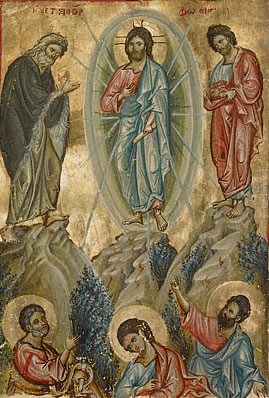
Jesus is shown to be the true son that Abraham rejoiced to see (see Matthew 1:1; John 8:56). In His transfiguration, He is revealed to be the “prophet like Moses” foretold by God—raised from among their own kinsmen, speaking with God’s own authority (see Deuteronomy 18:15,19).
Like Moses, He climbs the mountain with three named friends and beholds God’s glory in a cloud (see Exodus 24:1,9,15). He is the one prophesied to come after Elijah’s return (see Sirach 48:9-10; Malachi 3:1,23-24).
And, as He discloses to the apostles, He is the Son of Man sent to suffer and die for our sins (see Isaiah 53:3).
As we sing in today’s Psalm, Jesus believed in the face of His afflictions, and God loosed Him from the bonds of death (see Psalm 116:3).
His rising should give us the courage to face our trials, to offer ourselves totally to the Father—as He did, as Abraham and Isaac did.
Freed from death by His death, we come to this Mass to offer the sacrifice of thanksgiving, and to renew our vows—as His servants and faithful ones.
Binding Isaac, Crucifying Jesus
In the second and fourth Sundays of Lent (Cycle B), we see an ancient symbolic reading of the Old Testament—Abraham’s “binding” of Isaac as a symbol of God’s love for the world in giving His only son.
In Genesis 22, Abraham brings his firstborn, his only son, the one he loves, to offer him as a sacrifice. On the third day (see Genesis 22:4), an angel gives him his son back—not dead as expected, but alive. And this sacrificial offering leads God to promise to bless all the nations of the earth.
The New Testament writers read this story as symbolizing the sacrifice of Jesus on the cross.
In fact, God’s praise of Abraham for not withholding His only Son is echoed by Paul (see Romans 8:32) and John (see John 3:16). Hebrews says Abraham believed in the resurrection, and that Isaac’s release was a “symbol” of Christ’s resurrection (see Hebrews 11:17-19).
Jesus is the true heir promised to Abraham (see Matthew 1:1; Galatians 3:16). Abraham rejoiced at Isaac’s birth because he could foresee the day when Christ would be born (see John 8:56). Like Isaac, Christ carried the wood of His sacrifice (see Genesis 22:6; John 19:6).
And by His sacrificial death and resurrection the blessing of Abraham was extended to the nations (see Galatians 3:14; Genesis 22:16-18).
Anastasius of Sinai
A Sermon for the Feast of the Transfiguration
“They [were] questioning what rising from the dead meant”
Jesus manifested himself in glory on Mount Thabor, giving his disciples a divine revelation, a foreshadowing of the kingdom of heaven. It was as if he said: “So that you may not fall into disbelief as time goes by, now, at this moment, there are some standing here who will not taste death before they see the Son of man coming in the glory of his Father” (Mt 16,28)… These are the miracles of our present feast… For it is this celebration, this feast of Christ, which has brought us together here today.
In order to penetrate into the heart of these awe-inspiring mysteries with the disciples whom our Lord chose, let us listen to the holy voice of God which summons us from on high…: “Come, shout aloud to the mountain of the Lord, on the day of the Lord, to the place of the Lord and in the house of your God.”
Let us give heed that, illumined by the vision, transformed and transported… we may invoke this light, saying: “How awesome is this place; this is nothing other than the house of God and the gate of heaven” (Gn 28,17).
There we must hasten like Jesus who is our leader and has gone before us into heaven. There, with him, may the eyes of our mind shine with his light and the features of our soul be made new; may we be transfigured with him and moulded to his image, ever becoming divine, being transformed in an ever greater degree of glory…
Let us run there, eager and joyful, and let us be enveloped in the cloud, like Moses and Elijah, or James and John. Be like Peter, rapt at the divine vision, transfigured by the glory of the transfiguration, lifted high above the things of this world. Let us leave the flesh and creation behind and turn to the Creator, to whom Peter in ecstasy said: “Lord, it is good for us to be here!” Yes indeed, Peter, it is good for us to be here with Jesus and to remain here for ever.
Pope Benedict XVI
Angelus, March 4, 2012
This Sunday, the Second Sunday of Lent, is known as the Transfiguration of Christ. Indeed in the Lenten itinerary, having invited us to follow Jesus into the wilderness to face and overcome the temptations with him, the Liturgy now proposes that we climb the “mountain” of prayer with him to contemplate God’s glorious radiance on his human face. The episode of the Transfiguration of Christ is unanimously attested by the Evangelists Matthew, Mark and Luke.
There are two essential elements: first of all, Jesus leads the disciples Peter, James and John up a high mountain and there “he was transfigured before them” (Mk 9:2) and his face and his garments shone with dazzling light while Moses and Elijah appeared beside him; the second, a cloud overshadowed the mountain peak and from it came a voice saying: “This is my beloved Son; listen to him” (Mk 9:7). Thus, light and the voice: the divine radiance on Jesus’ face, and the voice of the heavenly Father that witnesses to him and commands that he be listened to.
The mystery of the Transfiguration must not be separated from the context of the path Jesus is following. He is now decisively oriented to fulfilling his mission, knowing all too well that to arrive at the Resurrection he must pass through the Passion and death on the Cross. He had spoken openly of this to his disciples; but they did not understand, on the contrary they rejected this prospect because they were not reasoning in accordance with God, but in accordance with men (cf. Mt 16:23).
It is for this reason that Jesus takes three of them with him up the mountain and reveals his divine glory, the splendour of Truth and of Love. Jesus wants this light to illuminate their hearts when they pass through the thick darkness of his Passion and death, when the folly of the Cross becomes unbearable to them. God is light, and Jesus wishes to give his closest friends the experience of this light which dwells within him.
After this event, therefore, he will be an inner light within them that can protect them from any assault of darkness. Even on the darkest of nights, Jesus is the lamp that never goes out. St Augustine sums up this mystery in beautiful words, he says: “what this sun is to the eyes of the flesh, that is [Christ] to the eyes of the heart” (Sermones 78, 2: PL 38, 490).
Dear brothers and sisters, we all need inner light to overcome the trials of life. This light comes from God and it is Christ who gives it to us, the One in whom the fullness of deity dwells (cf. Col 2:9). Let us climb with Jesus the mountain of prayer and, contemplating his face full of love and truth, let us allow ourselves to be filled with his light. Let us ask the Virgin Mary, our guide on the journey of faith, to help us to live out this experience in the season of Lent, finding every day a few moments for silent prayer and for listening to the Word of God.
Pope Benedict XVI
Angelus, March 8, 2009
Once again, the liturgy proposes this well-known episode on this very day, the Second Sunday of Lent (cf. Mk 9: 2-10). Jesus wanted his disciples in particular those who would be responsible for guiding the nascent Church to have a direct experience of his divine glory, so that they could face the scandal of the Cross.
Indeed, when the hour of betrayal came and Jesus withdrew to the Garden of Gethsemani, he kept the same disciples Peter, James and John close to him, asking them to watch and pray with him (cf. Mt 26: 38). They were not to succeed in doing so, but the grace of Christ was to sustain them and help them to believe in the Resurrection.
I wish to emphasize that the Transfiguration of Jesus was essentially an experience of prayer (cf. Lk 9: 28-29). Indeed, prayer reaches its culmination and thus becomes a source of inner light when the spirit of the human being adheres to that of God and their respective wills merge, as it were, to become a whole.
When Jesus went up the mountain, he was immersed in contemplation of the loving plan of the Father, who had sent him into the world to save humanity. Elijah and Moses appeared beside Jesus, meaning that the Sacred Scriptures were in concordance with the proclamation of his Paschal Mystery; that in other words Christ had to suffer and die in order to enter into his glory (cf. Lk 24: 26, 46).
At that moment Jesus saw silhouetted before him the Cross, the extreme sacrifice necessary in order to free us from the dominion of sin and death. And in his heart, once again, he repeated his “Amen”. He said yes, here I am, may your loving will be done, O Father. And as had happened after his Baptism in the Jordan, from Heaven there came signs of God the Father’s pleasure: the light that transfigured Christ and the voice that proclaimed him “my beloved Son” (Mk 9: 7).
Together with fasting and works of mercy, prayer is the backbone of our spiritual life. Dear brothers and sisters, I urge you to find in this Lenten Season prolonged moments of silence, possibly in retreat, in order to review your own lives in the light of the loving plan of the heavenly Father. Let yourselves be guided in this more intense listening to God by the Virgin Mary, a teacher and model of prayer. Even in the thick darkness of Christ’s Passion, she did not lose the light of her divine Son but rather treasured it in her heart. For this we call on her as Mother of Trust and Hope!
Pope Benedict XVI
Angelus, March 12, 2006
Today’s Gospel reading also reminds us of this, re-proposing to us the episode of the Transfiguration of Christ on Mount Tabor. Awestruck at the sight of the transfigured Lord who was speaking with Moses and Elijah, Peter, James and John were suddenly overshadowed by a cloud, out of which came a voice which proclaimed: “This is my beloved Son on whom my favour rests; listen to him” (Mk 9: 7).
When one has the grace to live a strong experience of God, it is as if one is living an experience similar to that of the disciples during the Transfiguration: a momentary foretaste of what will constitute the happiness of Paradise. These are usually brief experiences that are sometimes granted by God, especially prior to difficult trials.
No one, however, is permitted to live “on Tabor” while on earth. Indeed, human existence is a journey of faith and as such, moves ahead more in shadows than in full light, and is no stranger to moments of obscurity and also of complete darkness. While we are on this earth, our relationship with God takes place more by listening than by seeing; and the same contemplation comes about, so to speak, with closed eyes, thanks to the interior light that is kindled in us by the Word of God. Mary’s pilgrimage of faith
The Virgin Mary herself, among all human creatures the closest to God, still had to walk day after day in a pilgrimage of faith (cf. Lumen Gentium, n. 58), constantly guarding and meditating on in her heart the Word that God addressed to her through Holy Scripture and through the events of the life of her Son, in whom she recognized and welcomed the Lord’s mysterious voice.
And so, this is the gift and duty for each one of us during the season of Lent: to listen to Christ, like Mary. To listen to him in his Word, contained in Sacred Scripture. To listen to him in the events of our lives, seeking to decipher in them the messages of Providence. Finally, to listen to him in our brothers and sisters, especially in the lowly and the poor, to whom Jesus himself demands our concrete love. To listen to Christ and obey his voice: this is the principle way, the only way, that leads to the fullness of joy and of love.
Saint Jerome
Homilies on Saint Mark’s gospel, no. 6, SC 494
Christ, foretold by the Law and the prophets, only Savior of humankind
“Then Peter said to Jesus in reply, Rabbi, it is good for us to be here.” When I read Scripture and spiritually understand some sublime teaching neither do I want to descend to humbler realities. I want to make a tent in my heart for Christ, the Law and the prophets. But Jesus, who came to save what was lost, who did not come to save those who are saints but those who are sick, knows that if he remains on the mountain, if he does not go back down to earth, humankind will not be saved.
“Suddenly looking around, they no longer saw anyone.” When I read the gospel and see the testimonies of the Law and the prophets there, it is Christ alone that I consider: I haven’t seen Moses, I haven’t seen the prophets except to understand that they are speaking of Christ. When in the end I reach the splendor of Christ and perceive, as it were, the resplendent light of the sun’s radiance, I cannot see the light of a lamp. If one lights a lamp in full daylight, can it cast light? If the sun is shining then lamplight is invisible. In the same way, the Law and the prophets are completely invisible by comparison in the presence of Christ. I am not criticizing the Law and the prophets, rather I praise them because they announce Christ, but I read the Law and the prophets without wanting to enclose myself in the Law and the prophets but so as to come, by means of the Law and the prophets, to Christ. To Him, with the Father and Holy Spirit, all glory and honor to endless ages for ever and ever. Amen.