Darkness at Noon
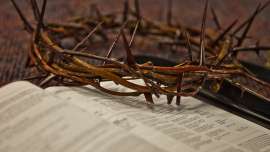
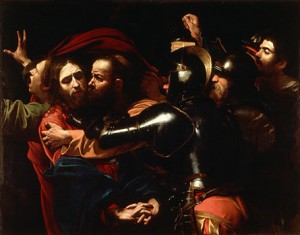
Crowned with thorns, our Lord is lifted up on the cross, where He dies as “King of the Jews.” Notice how many times He is called “king” in today’s Gospel—mostly in scorn and mockery. As we hear the long accounts of His passion, at every turn we must remind ourselves—He suffered this cruel and unusual violence, for us. He is the Suffering Servant foretold by Isaiah in today’s First Reading. He reenacts the agony described in today’s Psalm, and even dies with the first words of that Psalm on His lips (see Psalm 22:1). Listen carefully for the echoes of this Psalm throughout today’s Gospel—as Jesus is beaten, His hands and feet are pierced; as His enemies gamble for His clothes, wagging their heads, mocking His faith in God’s love, His faith that God will deliver Him. Are we that much different from our Lord’s tormenters? Often, don’t we deny that He is king, refusing to obey His only commands that we love Him and one another? Don’t we render Him mock tribute, pay Him lip-service with our half-hearted devotions? In the dark noon of Calvary, the veil in Jerusalem’s temple was torn. It was a sign that by His death Jesus destroyed forever the barrier separating us from the presence of God. He was God and yet humbled himself to come among us, we’re reminded in today’s Epistle. And despite our repeated failures, our frailty, Jesus still humbles himself to come to us, offering us His body and blood in the Eucharist. His enemies never understood: His kingship isn’t of this world (see John 18:36). He wants to write His law, His rule of life on our hearts and minds. As we enter Holy Week, let us once more resolve to give Him dominion in our lives. Let us take up the cross He gives to us—and confess with all our hearts, minds, and strength, that truly this is the Son of God.
St. Andrew of Crete (660-740)
from Sermon for Palm Sunday Have courage, daughter of Zion, do not be afraid. “Behold, your king comes to you, humble and mounted on a colt, the foal of a beast of burden” (Zec 9,9). He is coming who is everywhere present and pervades all things; he is coming to achieve in you his work of universal salvation. He is coming “who came to call to repentance not the righteous but sinners” (Lk 5,32), coming to recall those who have strayed into sin.
Do not be afraid, then: “God is in the midst of you, and you shall not be shaken” (Ps 46[45],6) Receive him with open, outstretched hands, for it was on his own hands that he sketched you. Receive him who laid your foundations on the palms of his hands. Receive him, for he took upon himself all that belongs to us except sin, to consume what is ours in what is his… Rejoice exceedingly, daughter of Jerusalem, sing and leap for joy… “Be enlightened, for the light has come to you and the glory of the Lord has risen over you” (Is 60,1).
What kind of light is this? It is that “which enlightens every man coming into the world” (Jn 1,9). It is the everlasting light… revealed in time, the light manifested in the flesh although hidden by nature, the light that shone round the shepherds and guided the Magi. It is the light that was in the world from the beginning, through which the world was made, yet the world did not know it. It is that light which came to its own, and its own people did not receive it.
And what is this glory of the Lord? Clearly it is the cross on which Christ was glorified, he, the radiance of the Father’s glory, even as he said when he faced his passion: “Now is the Son of Man glorified, and God is glorified in him, and will glorify him at once” (Jn 13,31). The glory of which he speaks here is his lifting up on the cross, for Christ’s glory is his cross and his exultation upon it, as he plainly says: “When I have been lifted up, I will draw all men to myself” (Jn 12,32).
St. Epiphanius of Salamis
Sermon for Palm Sunday (PG 43, 427)
“Rejoice! Daughter of Sion” (Zac 9,9), be joyful and shout for joy, Church of God, for see!, your King comes to you, your Bridegroom is coming, seated on an ass as on a throne! Let us hasten before him to behold his glory. See the salvation of the world: our God proceeding towards his cross. Let us, too, the peoples, cry aloud today with the crowd: “Hosanna to the Son of David, save us in the highest, O God!” (Mt 21,9; Ps 118[117],25 hebr)…
This is a feast day that the Church is celebrating under Christ’s shadow, the olive tree who bears fruit in the house of God (Ps 52[51],10). With Christ, flowering lily in the springtime of Paradise, she is celebrating a day of festival. For Christ stands in the midst of the Church, he the true lily in blossom, root of Jesse who does not judge the world but serves it (Is 11,1.3).
He stands in the midst of the Church, the eternal spring from whom no longer well the rivers of paradise (Gn 2,10) but Matthew, Mark, Luke and John who water the garden of Christ’s Church. Today, we who are fruitful young olive plants (cf. Ps 128[127],3), holding olive branches in our hands, pray to the Christ of mercy. “Planted in the house of the Lord”, blossoming at springtime in “the courts of the house of our God”, let us celebrate a day of festival: “winter is over and gone!” (Ps 92[91],14; Sg 2,11)…
With Paul I exclaim in a voice that is holy and strong: “The old things have passed away; behold, new things have come” (2Cor 5,17)… A certain prophet, seeing this king, cried out: “Behold, the Lamb of God who takes away the sin of the world” (Jn 1,29)…; and David, looking towards Christ, descended from his race according to the flesh, said:”The Lord is God and has appeared among us” (cf. Ps 118[117],27 LXX).
O admirable feast day, extraordinary, astonishing! The children acclaim Christ as God but the priests curse him; the children worship him and the Doctors of the Law despise and speak ill of him. The children say: “Hosanna!” and his enemies shout: “Crucify!” The former surround Christ carrying palms, the latter attack him with swords; the former cut down branches, the latter prepare a cross.
Pope Benedict XVI
Homily April 9, 2006
Dear Brothers and Sisters,
For 20 years, thanks to Pope John Paul II, Palm Sunday has become in a special way a day for youth – the day on which all young people across the world go to meet Christ, eager to accompany him to their cities and their countries, so that he may be among us and establish his peace in the world. However, if we want to encounter Jesus and then to walk with him on his path, we must ask: on what path does he want to lead us? What do we expect of him? What does he expect of us?
To understand what happens on Palm Sunday and to know what this means, not only for that hour but for all time, one detail has proved to be important; it also became the key to understanding the event for his disciples too, when they looked back after Easter with new eyes at those tumultuous days.
Jesus entered the Holy City riding on a donkey, that is, the animal of the simple, common country people, and moreover, it was an ass that did not belong to him but one he had asked to borrow for the occasion.
He did not arrive in an ostentatious royal carriage or on horseback like the great figures of the world, but on a borrowed donkey. John tells us that at first the disciples did not understand his action. Only after Easter did they realize that Jesus, by so acting, was fulfilling what the prophets had foretold: that his action derived from God’s Word and was bringing it to fulfilment.
It should be remembered, John said, that in the Book of the Prophet Zechariah we read: “Fear not, daughter of Zion; behold, your king is coming, sitting on the colt of an ass” (Jn 12: 15; cf. Zec 9: 9). To understand the significance of the prophecy and, consequently, of Jesus’ behaviour, we must listen to the whole of Zechariah’s text, which continues thus: “He shall banish the chariot from Ephraim, and the horse from Jerusalem; the warrior’s bow shall be banished, and he shall proclaim peace to the nations. His dominion will be from sea to sea, and from the river to the ends of the earth” (cf. 9: 10).
With that, the Prophet says three things about the future king. In the first place he says that he will be a king of the poor, a poor man among the poor and for the poor. In this case poverty is meant in the sense of the anawim of Israel, of those believing and trusting souls that we meet around Jesus – in the perspective of the first Beatitude of the Sermon on the Mount.
A person can be materially poor yet his heart can be full of greed for wealth and for the power that derives from it. The very fact that he lives with envy and covetousness shows that, in his heart, he is one of the rich. He wants to reverse the division of goods so that he himself can take over the situation that was previously theirs.
The poverty that Jesus means – that the prophets mean – presupposes above all inner freedom from the greed for possession and the mania for power. This is a greater reality than merely a different distribution of possessions, which would still be in the material domain and thereby make hearts even harder. It is first and foremost a matter of purification of heart, through which one recognizes possession as responsibility, as a duty towards others, placing oneself under God’s gaze and letting oneself be guided by Christ, who from being rich became poor for our sake (cf. II Cor 8: 9).
Inner freedom is the prerequisite for overcoming the corruption and greed that devastate the world today. This freedom can only be found if God becomes our richness; it can only be found in the patience of daily sacrifices, in which, as it were, true freedom develops. It is the King who points out to us the way to this goal: Jesus, whom we acclaim on Palm Sunday, whom we ask to take us with him on his way.
The second thing the prophet shows us is that this king will be a king of peace: he will cause chariots of war and war horses to vanish, he will break bows and proclaim peace.
This is brought about in Jesus through the sign of the Cross. The Cross is the broken bow, in a certain way, God’s new, true rainbow which connects the heavens and the earth and bridges the abysses between the continents. The new weapon that Jesus places in our hands is the Cross – a sign of reconciliation, of forgiveness, a sign of love that is stronger than death.
Every time we make the Sign of the Cross we should remember not to confront injustice with other injustice or violence with other violence: let us remember that we can only overcome evil with good and never by paying evil back with evil.
The third affirmation of the prophet is the preannouncement of universality. Zechariah says that the kingdom of the king of peace extends “from sea to sea… to the ends of the earth”. The ancient promise of the earth, made to Abraham and to the Fathers, is replaced here by a new vision: the domain of the Messianic King is no longer a specific country that would later necessarily be separated from other countries and hence, inevitably, would take a stance against them. His country is the earth, the whole world.
He creates unity in the multiplicity of cultures, overcoming every boundary. By perceptively penetrating the clouds of history that separated the Prophet from Jesus, we see in this prophecy, emerging from the distant horizon of prophecy, the network of Eucharistic communities that embraces the earth, the whole world – a network of communities that constitutes Jesus’ “Kingdom of peace”, which extends from sea to sea, to the ends of the earth.
He comes in all cultures and all parts of the world, everywhere, in wretched huts and in poor rural areas as well as in the splendour of cathedrals. He is the same everywhere, the One, and thus all those gathered with him in prayer and communion are also united in one body. Christ rules by making himself our Bread and giving himself to us. It is in this way that he builds his Kingdom.
This connection becomes quite clear in the other words from the Old Testament which characterize and explain the Palm Sunday liturgy and its special atmosphere. The crowds acclaim Jesus: “Hosanna! Blessed is he who comes in the name of the Lord” (Mk 11: 9; Ps 118[117]: 25ff.).
These words are part of the rite of the Feast of Tabernacles, during which the faithful move in a circle around the altar, holding in their hands branches of palm, myrtle and willow.
Now, their palms in their hands, the people raise this cry before Jesus, in whom they see the One who comes in the name of the Lord. The phrase: “He who comes in the name of the Lord”, in fact, had long before become the designation of the Messiah.
In Jesus, they recognize the One who truly comes in the name of the Lord and brings God’s presence among them. In the Church, this cry of hope of Israel, this acclamation of Jesus during his entry into Jerusalem, has with good reason become the acclamation of the One who comes in the Eucharist to meet us in a new way. We greet with the cry of “Hosanna!”, the One who brought God’s glory to the earth in flesh and blood.
We greet the One who came yet always remains, the One who is to come. We greet the One who, in the Eucharist, always comes to us again in the name of the Lord, thus joining the ends of the earth in God’s peace.
This experience of universality is an essential part of the Eucharist. Since the Lord comes, we emerge from our exclusive forms of particularism and enter into the great community of all who are celebrating this holy sacrament. We enter his Kingdom of peace and in him, in a certain way, we greet all our brothers and sisters to whom he comes, to become truly a kingdom of peace in the midst of this lacerated world.
All three characteristics announced by the Prophet – poverty, peace, universality – are summed up in the sign of the Cross. Therefore, with good reason, the Cross has become the centre of the World Youth Days.
There was a time – and it has not yet been completely surmounted – in which Christianity was rejected precisely because of the Cross. The Cross speaks of sacrifice, it was said, the Cross is the sign of the denial of life. Instead, we want life in its entirety, without restrictions and without sacrifices. We want to live, all we want is to live. Let us not allow ourselves to be limited by precepts and prohibitions; we want richness and fullness – this is what was said and is still being said.
All this sounds convincing and seductive; it is the language of the serpent that says to us: “Do not be afraid! Quietly eat the fruit of all the trees in the garden!”.
Palm Sunday, however, tells us that the great “Yes” is precisely the Cross, that the Cross itself is the true tree of life. We do not find life by possessing it, but by giving it. Love is a gift of oneself, and for this reason it is the way of true life symbolized by the Cross.
Today, the Cross that was recently the focus of the World Youth Day in Cologne is being consigned to a special delegation so that it may begin the journey to Sydney, where in 2008 the youth of the world are planning to meet again around Christ to build with him the Kingdom of peace.
From Cologne to Sydney – a journey across continents and cultures, a journey through a world torn and tormented by violence! Symbolically, it is like the journey the prophet pointed out from sea to sea, from the river to the ends of the earth. It is the journey of the One who, in the sign of the Cross, gives us peace and makes us become messengers of reconciliation and of his peace.
I thank the young people who will now carry this Cross, in which we can as it were touch the mystery of Jesus on the highways of the world. Let us pray that at the same time, it will touch us and open our hearts, so that by following his Cross we will become messengers of his love and his peace. Amen.