Spiritual Sacrifices
Jesus does not come to destroy the temple, but to fulfill it (see Matthew 5:17)—to reveal its true purpose in God’s saving plan.
He is the Lord the prophets said would come—to purify the temple, banish the merchants, and make it a house of prayer for all peoples (see Zechariah 14:21; Malachi 3:1-5; Isaiah 56:7).
The God who made the heavens and the earth, who brought Israel out of slavery, does not dwell in sanctuaries made by human hands (see Acts 7:48; 2 Samuel 7:5).
Nor does He need offerings of oxen, sheep, or doves (see Psalm 50:7-13).
Notice in today’s First Reading that God did not originally command animal sacrifices—only that Israel heed His commandments (see Jeremiah 7:21-23; Amos 5:25).
His law was a gift of divine wisdom, as we sing in today’s Psalm. It was a law of love (see Matthew 22:36-40), perfectly expressed in Christ’s self-offering on the cross (see John 15:13)
This is the “sign” Jesus offers in the Gospel today—the sign that caused Jewish leaders to stumble, as Paul tells us in the Epistle.
Jesus’ body—destroyed on the cross and raised up three days later—is the new and true sanctuary. From the temple of His body, rivers of living water flow, the Spirit of grace that makes each of us a temple (see 1 Corinthians 3:16), and together builds us into a dwelling place of God (see Ephesians 2:22).
In the Eucharist we participate in His offering of His body and blood. This is the worship in Spirit and in truth that the Father desires (see John 4:23-24).
We are to offer praise as our sacrifice (see Psalm 50:14,23). This means imitating Christ—offering our bodies—all our intentions and actions in every circumstance, for the love of God and the love of others (see Hebrews 10:5-7; Romans 12:1; 1 Peter 2:5).
Origen
Commentary on St. John’s Gospel, 10
The mystery of our resurrection is great indeed and extremely difficult to fathom. It is foretold in many texts of Scripture but, above all, in Ezekiel…: “The Spirit of the Lord set me down in a valley full of bones…; they were completely dry. The Lord said to me: ‘Son of man, can these bones come to life?’ ‘Lord God,’ I answered, ‘you alone know that!’ Then he said to me: ‘Prophesy over these bones, and say to them: Dry bones, hear the word of the Lord!’ (Ez 37,1-4)…
So what are those bones to which it is said: “Hear the word of the Lord”… if not the Body of Christ, of which the Lord said: “All my bones are racked” (Ps 22[21],15)… Just as the resurrection of Christ’s true and perfect body came about, so the members of Christ will one day… be reunited, bone to bone, ligament to ligament.
Anybody without this ligament will not come to “mature manhood, to the extent of the full stature of Christ’s body” (Eph 4,13). Then… “all the parts of the body, though many, will make one body” (1Cor 12,12)…
I tell you this with respect to the Temple – of which our Lord said: “Zeal for your house has consumed me” (Ps 69[68],10) – and to the Jews who asked him for a sign and with respect to his reply:…: “Destroy this Temple and in three days I will raise it up again.” For everything that disavows reason and arises from business affairs must be cast out of this temple, which is the Body of Christ, so that in future this temple will not be a house of buyers and sellers any more.
Furthermore… after its destruction by those who turn away from God’s word, it is to be raised up again on the third day… Following Jesus’ purification, his disciples, having forsaken all senseless things and every sort of business, and as a consequence of their zeal for God’s Word present within them, will be “destroyed” so as to be “raised up again” by Jesus in three days… For three whole days are necessary for this rebuilding to be fulfilled.
Hence we can say that, on the one hand, the resurrection has taken place and, on the other, that it is still to come. In truth, “we have been buried with Christ” and “we shall be raised up with him” (cf. Rm 6,4)… “In Christ shall all be brought to life, but each one according to its proper order: Christ the firstfruits and then, at his coming, those who belong to Christ” (1Cor 15,22-23).
Pope Benedict XVI
Homily, March 19, 2006
We have listened together to a famous and beautiful passage from the Book of Exodus, in which the sacred author tells of God’s presentation of the Decalogue to Israel. One detail makes an immediate impression: the announcement of the Ten Commandments is introduced by a significant reference to the liberation of the People of Israel. The text says: “I am the Lord your God, who brought you out of the land of Egypt, out of the house of bondage” (Ex 20: 2).
Thus, the Decalogue is intended as a confirmation of the freedom gained. Indeed, at a closer look, the Commandments are the means that the Lord gives us to protect our freedom, both from the internal conditioning of passions and from the external abuse of those with evil intentions. The “nos” of the Commandments are as many “yeses” to the growth of true freedom.
There is a second dimension of the Decalogue that should also be emphasized: by the Law which he gave through Moses, the Lord revealed that he wanted to make a covenant with Israel. The Law, therefore, is a gift more than an imposition. Rather than commanding what the human being ought to do, its intention is to reveal to all the choice of God: He takes the side of the Chosen People; he set them free from slavery and surrounds them with his merciful goodness. The Decalogue is a proof of his special love.
Today’s liturgy offers us a second message: The Mosaic Law was totally fulfilled in Jesus, who revealed God’s wisdom and love through the mystery of the Cross, “a stumbling block to Jews and an absurdity to Gentiles; but to those who are called, Jews and Greeks alike, Christ is the power of God and the wisdom of God” (I Cor 1: 23-24).
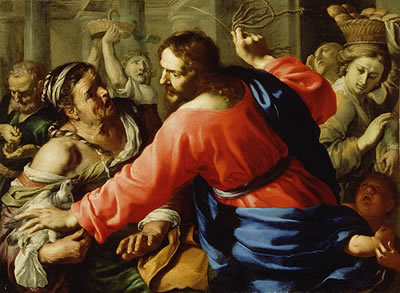
The Gospel just proclaimed refers precisely to this: Jesus drove the merchants and money-changers out of the temple. Through the verse of a Psalm: “Zeal for your house has consumed me” (cf. Ps 69[68]: 10), the Evangelist provides a key for the interpretation of this significant episode. And Jesus was “consumed” by this “zeal” for the “house of God”, which was being used for purposes other than those for which it was intended.
To the amazement of everyone present, he responded to the request of the religious leaders who demand evidence of his authority by saying: “Destroy this temple, and in three days I will raise it up” (Jn 2: 19). These are mysterious words that were incomprehensible at the time; John, however, paraphrased them for his Christian readers, saying: “Actually, he was talking about the temple of his body” (Jn 2: 21).
His enemies were to destroy that “temple”, but after three days he would rebuild it through the Resurrection. The distressful “stumbling block” of Christ’s death was to be crowned by the triumph of his glorious Resurrection.
In this Lenten season, while we are preparing to relive this central event of our salvation in the Easter triduum, we are already looking at the Crucified One, seeing in him the brightness of the Risen One.
Saint Leo the Great
Sermon 48, 1; PL 54, 298
“He was speaking about the temple of his body”
If we consider what the whole world has received through the cross of the Lord, then we shall recognize that if we are to celebrate Easter then it is only right to prepare ourselves with a fast of forty days…
It is not just bishops or priests or only the ministers of the sacraments but the whole body of the Church, it is the entire assembly of the faithful who are to purify themselves from every blemish so that God’s temple, whose foundation is its own founder (see 1Cor 3:11.16), may be beautiful in all its stones and radiant in all its aspects… There is no doubt that no one can undertake or complete this temple’s purification without its builder, yet he who built it also allowed him to be able to seek for its growth through his own labor. For it was living and intelligent material that served for the construction of this temple and it is the Spirit of grace that prompts it to adhere willingly into a single edifice…
And so, since all the faithful as a whole and each one in particular form one and the same temple of God, it has to be just as perfect in each as it must be in its entirety. For even if its beauty cannot be identical in all its members nor its merits the same in such a great variety of parts, yet the bond of charity obtains communion in beauty. Even if they have not received the same gifts of grace, those who are united by holy love enjoy their blessings together and what they love in others cannot be foreign to themselves since they themselves increase their riches by finding their joy in the progress of others.