Living in the Light
The Sunday readings in Lent have been showing us the high points of salvation history—God’s covenant with creation in the time of Noah; His promises to Abraham; the law He gave to Israel at Sinai. In today’s First Reading, we hear of the destruction of the kingdom established by God’s final Old Testament covenant—the covenant with David (see 2 Samuel 7; Psalm 89:3). His chosen people abandoned the law He gave them. For their sins, the temple was destroyed, and they were exiled in Babylon. We hear their sorrow and repentance in the exile lament we sing as today’s Psalm. But we also hear how God, in His mercy, gathered them back, even anointing a pagan king to shepherd them and rebuild the temple (see Isaiah 44:28–45:1,4). God is rich in mercy, as today’s Epistle teaches. He promised that David’s kingdom would last forever, that David’s son would be His Son and rule all nations (see 2 Samuel 7:14-15; Psalm 2:7-9). In Jesus, God keeps that promise (see Revelation 22:16).
Moses lifted up the serpent as a sign of salvation (see Wisdom 16:6-7; Numbers 21:9). Now Jesus is lifted up on the cross, to draw all people to himself (see John 12:32).
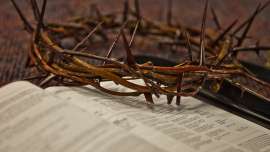
Those who refuse to believe in this sign of the Father’s love, condemn themselves—as the Israelites in their infidelity brought judgment upon themselves. But God did not leave Israel in exile, and He does not want to leave any of us dead in our transgressions. We are God’s handiwork, saved to live as His people in the light of His truth. Midway through this season of repentance, let us again behold the Pierced One (see John 19:37), and rededicate ourselves to living the “good works” that God has prepared us for.
St. Ephrem
Sermon on Repentance
St. Ephrem (c. 306-373)from Sermon on r When the people sinned in the desert (Nm 21,5f.), Moses, who was a prophet, commanded the Israelites to mount a serpent on a cross, in other words to put sin to death… They had to look at a serpent because it was with serpents that the children of Israel had been struck as their punishment.
And why with serpents? Because they had repeated our first parents’ action. Adam and Eve had both sinned by eating the fruit of the tree; the Israelites had also complained regarding a question of food. To move words of complaint because they lacked vegetables is the limit of complaining! This is what the psalm testifies: “they rebelled against God in the wasteland” (Ps 78[77],17). So, in Paradise too, the serpent was the source of complaining…
In this way the children of Israel were to learn that the very same serpent that had plotted Adam’s death had brought death to them, too. And so Moses hung it on the pole so that, when they saw it, its likeness would lead them to remember the tree.
For those who turned their eyes towards it were saved, not indeed by the serpent but in consequence of their conversion. They looked at the serpent and were reminded of their sin. Because they were bitten, they repented and, once again, were saved. Their conversion transformed the desert into a dwelling-place of God; through repentance the sinful people became an ecclesial assembly and, still better, worshipped the cross in spite of it.
Joseph Cardinal Ratzinger [Pope Benedict XVI] Sermons for Lent 1981
“Have among yourselves the same attitude that is also yours in Christ Jesus: who, though he was in the form of God, did not regard equality with God something to be grasped. Rather, he emptied himself, taking the form of a slave, coming in human likeness; and found human in appearance, he humbled himself, becoming obedient to the death, even death on a cross! Because of this, God greatly exalted him and bestowed on him a name that is above every name” (Phil 2,5-9)…
This exceptionally rich text clearly alludes to the first fall… Jesus Christ goes back over Adam’s footsteps. Unlike Adam he is indeed “like God” (cf Gn 3,5). But to be like God, equal to God, is to «be Son» and thus wholly in relationship: “The Son can do nothing of himself” (Jn 5,19).
That is why he who is truly equal to God does not cling to his own autonomy, to the limitless nature of what he can and will do. Because he travels the road backwards, he becomes the wholly dependant, he becomes servant. Because he does not take the way of power but the way of love he can descend down to Adam’s deceit, down to death, and there raise up the truth, give life.
Thus Christ becomes the new Adam through whom human life assumes a new start…
The cross, the locus of his obedience, thus becomes the true tree of life. Christ becomes the image set against the serpent, as John says in his gospel. From this tree it is not the word of temptation but the word of saving love that emanates, the word of obedience through which God himself becomes obedient and thus offers his obedience to us as an arena of liberty.
The cross is the newly accessible tree of life. Christ, in his Passion, has turned aside the flaming sword, so to speak (Gn 3,24), has passed through the fire and set up the cross as the world’s true axis on which the world is raised up. That is why the Eucharist, as the presence of the cross, is the tree of life remaining amongst us always and inviting us to receive the fruits of true life.
Pope Benedict XVI
Homily, March 26, 2006
This Fourth Sunday of Lent, traditionally known as “Laetare Sunday”, is permeated with a joy which, to some extent, attenuates the penitential atmosphere of this holy season: “Rejoice Jerusalem!”, the Church says in the Entrance Antiphon, “Be glad for her… you who mourned for her”.
The refrain of the Responsorial Psalm echoes this invitation: “The memory of you, Lord, is our joy”. To think of God gives joy. We spontaneously ask ourselves: but why should we rejoice? One reason, of course, is the approach of Easter. The expectation of Easter gives us a foretaste of the joy of the encounter with the Risen Christ.
The deepest reason, however, lies in the message offered by the biblical readings that the liturgy presents to us today and that we have heard. They remind us that despite our unworthiness, God’s infinite mercy is destined for us. God loves us in a way that we might call “obstinate” and enfolds us in his inexhaustible tenderness.
This is what already emerges from the First Reading from the Book of Chronicles in the Old Testament (cf. II Chr 36: 14-16, 19-23). The sacred author offers us a concise and meaningful interpretation of the history of the Chosen People, who suffered God’s punishment as a consequence of their rebellious behaviour: the temple was destroyed and the people in exile no longer had a land; it truly seemed that God had forgotten them.
Then, however, they saw that God, through punishment, pursues a plan of mercy. It was to be the destruction of the Holy City and the temple – as I said -, it was to be an exile that would move the people’s hearts and bring them back to their God so that they might know him more deeply.
And then the Lord, demonstrating the absolute primacy of his initiative over every purely human effort, was to make use of a pagan, King Cyrus of Persia, to set Israel free.
In the text we have heard, the anger and mercy of the Lord alternate in a dramatic sequence, but love triumphs in the end, for God is love.
How can we fail to grasp from the memory of those distant events a message valid for all times, including our own? In thinking of the past centuries, we can see that God continues to love us even when he punishes us. Even when God’s plans pass through trial and punishment, they always aim at an outcome of mercy and forgiveness.
This is what the Apostle Paul confirmed for us in the Second Reading, recalling that “God, who is rich in mercy, out of the great love with which he loved us, even when we were dead through our trespasses, made us alive together with Christ” (Eph 2: 4-5).
To express this reality of salvation the Apostle, together with the term “mercy”, eleos in Greek, uses the word for love, agape, taken up and further amplified in the most beautiful statement which we heard in the Gospel passage: “God so loved the world that he gave his Only-begotten Son, that whoever believes in him should not perish but have eternal life” (Jn 3: 16).
As we know, that “giving” on the part of the Father had a dramatic development: it even went to the point of the sacrifice of the Son on the Cross.
If Jesus’ entire mission in history is an eloquent sign of God’s love, his death, in which God’s redeeming tenderness is fully expressed, is quite uniquely so. Always, but particularly in this Lenten Season, our meditation must be centred on the Cross. In it we contemplate the glory of the Lord that shines out in the martyred body of Jesus.
God’s greatness, his being love, becomes visible precisely in this total gift of himself. It is the glory of the Crucified One that every Christian is called to understand, live and bear witness to with his life. The Cross – the giving of himself on the part of the Son of God – is the definitive “sign” par excellence given to us so that we might understand the truth about man and the truth about God: we have all been created and redeemed by a God who sacrificed his only Son out of love.
This is why the Crucifixion, as I wrote in the Encyclical Deus Caritas Est, “is the culmination of that turning of God against himself in which he gives himself in order to raise man up and save him. This is love in its most radical form” (n. 12).
How should we respond to this radical love of the Lord?
The Gospel presents to us a person by the name of Nicodemus, a member of the Sanhedrin of Jerusalem who sought out Jesus by night. He was a well-to-do man, attracted by the Lord’s words and example, but one who hesitated to take the leap of faith because he was fearful of others. He felt the fascination of this Rabbi, so different from the others, but could not manage to rid himself of the conditioning of his environment that was hostile to Jesus, and stood irresolute on the threshold of faith.
How many people also in our time are in search of God, in search of Jesus and of his Church, in search of divine mercy, and are waiting for a “sign” that will touch their minds and their hearts!
Today, as then, the Evangelist reminds us that the only “sign” is Jesus raised on the Cross: Jesus who died and rose is the absolutely sufficient sign. Through him we can understand the truth about life and obtain salvation.
This is the principal proclamation of the Church, which remains unchanged down the ages. The Christian faith, therefore, is not an ideology but a personal encounter with the Crucified and Risen Christ. From this experience, both individual and communitarian, flows a new way of thinking and acting: an existence marked by love is born, as the saints testify.
Pope Benedict XVI
Homily, March 22, 2009
“God so loved the world that he gave his only Son, that whoever believes in him should not perish, but have eternal life” (Jn 3:16). These words fill us with joy and hope, as we await the fulfilment of God’s promises! …
Today’s first reading … is a message of hope addressed to the Chosen People in the land of their Exile, a summons to return to Jerusalem to rebuild the Lord’s Temple. Its vivid description of the destruction and ruin caused by war echoes the personal experience of so many people in this country amid the terrible ravages of the civil war.
How true it is that war can “destroy everything of value” (cf. 2 Chr 36:19): families, whole communities, the fruit of men’s labour, the hopes which guide and sustain their lives and work! … When God’s word – a word meant to build up individuals, communities and the whole human family – is neglected, and when God’s law is “ridiculed, despised, laughed at” (ibid., v. 16), the result can only be destruction and injustice: the abasement of our common humanity and the betrayal of our vocation to be sons and daughters of a merciful Father, brothers and sisters of his beloved Son.
So let us draw comfort from the consoling words which we have heard in the first reading! The call to return and rebuild God’s Temple has a particular meaning for each of us. Saint Paul … tells us that “we are the temple of the living God” (2 Cor 6:16). God dwells, we know, in the hearts of all who put their faith in Christ, who are reborn in Baptism and are made temples of the Holy Spirit.
Even now, in the unity of the Body of Christ which is the Church, God is calling us to acknowledge the power of his presence within us, to reappropriate the gift of his love and forgiveness, and to become messengers of that merciful love within our families and communities, at school and in the workplace, in every sector of social and political life. …
The Gospel teaches us that reconciliation, true reconciliation, can only be the fruit of conversion, a change of heart, a new way of thinking. It teaches us that only the power of God’s love can change our hearts and make us triumph over the power of sin and division. When we were “dead through our sins” (Eph 2:5), his love and mercy brought us reconciliation and new life in Christ. This is the heart of the Apostle Paul’s teaching, and it is important for us to remind ourselves: only God’s grace can create a new heart in us! Only his love can change our “hearts of stone” (cf. Ezek 11:19) and enable us to build up, rather than tear down. Only God can make all things new!
The words which Jesus speaks in today’s Gospel are quite striking: He tells us that God’s sentence has already been pronounced upon this world (cf. Jn 3:19ff). The light has already come into the world. Yet men preferred the darkness to the light, because their deeds were evil. How much darkness there is in so many parts of our world! …
Yet the word of God is a word of unbounded hope. “God loved the world so much that he gave his only Son … so that through him, the world might be saved” (Jn 3:16-17). God does not give up on us! He continues to lift our eyes to a future of hope, and he promises us the strength to accomplish it.
As Saint Paul tells us in today’s second reading, God created us in Christ Jesus “to live the good life”, a life of good deeds, in accordance with his will (cf. Eph 2:10). He gave us his commandments, not as a burden, but as a source of freedom: the freedom to become men and women of wisdom, teachers of justice and peace, people who believe in others and seek their authentic good. God created us to live in the light, and to be light for the world around us! This is what Jesus tells us in today’s Gospel: “The man who lives by the truth comes out into the light, so that it may be plainly seen that what he does is done in God” (Jn 3:21).
“Live”, then, “by the truth!” Radiate the light of faith, hope and love in your families and communities! Be witnesses of the holy truth that sets men and women free! … Living by the truth takes time, effort and perseverance: it has to begin in our own hearts, in the small daily sacrifices required if we are to be faithful to God’s law, in the little acts by which we demonstrate that we love our neighbours, all our neighbours, regardless of race, ethnicity or language, and by our readiness to work with them to build together on foundations that will endure.
Let your parishes become communities where the light of God’s truth and the power of Christ’s reconciling love are not only celebrated, but proclaimed in concrete works of charity.
And do not be afraid! Even if it means being a “sign of contradiction” (Lk 2:34) in the face of hardened attitudes and a mentality that sees others as a means to be used, rather than as brothers and sisters to be loved, cherished and helped along the path of freedom, life and hope. …
Dear brothers and sisters! At the end of today’s first reading, Cyrus, King of Persia, inspired by God, calls the Chosen People to return to their beloved land and to rebuildthe Temple of the Lord. May his words be a summons to all God’s People … Arise! (cf.2 Chr 36:23) Look to the future with hope, trust in God’s promises, and live in his truth. In this way, you will build something destined to endure, and leave to future generations a lasting inheritance of reconciliation, justice and peace. Amen.
Pope Benedict XVI
Angelus Address, March 18, 2012
On our way towards Easter we have reached the Fourth Sunday of Lent. It is a journey with Jesus through the “wilderness”, that is, a time in which to listen more attentively to God’s voice and also to unmask the temptations that speak within us. The Cross is silhouetted against the horizon of this wilderness. Jesus knows that it is the culmination of his mission: in fact the Cross of Christ is the apex of love which gives us salvation. Christ himself says so in today’s Gospel: just “as Moses lifted up the serpent in the wilderness, so must the Son of man be lifted up, that whoever believes in him may have eternal life” (Jn 3:14-15).
The reference is to the episode in which, during the Exodus from Egypt, the Jews were attacked by poisonous serpents and many of them died. God then commanded Moses to make a bronze serpent and to set it on a pole; anyone bitten by serpents was cured by looking at the bronze serpent (cf. Num 21:4-9). Jesus was to be raised likewise on the Cross, so that anyone in danger of death because of sin, may be saved by turning with faith to him who died for our sake: “for God sent the Son into the world, not to condemn the world, but that the world might be saved through him” (Jn 3:17).
St Augustine comments: “So far, then, as it lies with the physician, he has come to heal the sick. He that will not observe the orders of the physician destroys himself. He has come a Saviour to the world… You will not be saved by him; you shall be judged of yourself”. (On the Gospel of John 12, 12: PL 35, 1190). Therefore, if the merciful love of God — who went so far as to give his only Son to redeem our life — is infinite, we have a great responsibility: each one of us, in fact, must recognize that he is sick in order to be healed. Each one must confess his sin so that God’s forgiveness, already granted on the Cross, may have an effect in his heart and in his life.
St Augustine writes further: “God accuses your sins: and if you also accuse them, you are united to God…. When your own deeds will begin to displease you, from that time your good works begin, as you find fault with your evil works. The confession of evil works is the beginning of good works” (ibid., 13: PL 35, 1191).
Sometimes men and women prefer the darkness to the light because they are attached to their sins. Nevertheless it is only by opening oneself to the light and only by sincerely confessing one’s sins to God that one finds true peace and true joy. It is therefore important to receive the Sacrament of Penance regularly, especially during Lent, in order to receive the Lord’s forgiveness and to intensify our process of conversion.
Saint Francis de Sales
Collected Works vol.10 (in ‘The Book of the Four Loves,’ Annecy edition)
“God so loved the world that he gave his only Son”
Could God not supply the world with any other remedy than that of the death of his Son?… Most certainly. And he was able to redeem us by a thousand other means than the death of his Son. But he did not wish to because what was sufficient for our salvation was not so for satisfying his love. And to show us how much he loved us this divine Son died from the most harsh and ignominious of deaths as that of the cross.
What remains, then, and what consequence can we draw from this if not that, since he died for love of us, we too should die for love of him, or, if we are unable to die for love, at least we should not live otherwise than for him?… This is what the great Saint Augustine lamented about: “Lord,” he said, “is it possible someone should know you died for their sake and not live for you?” And that great lover, Saint Francis, used to say with sobs: “Ah, you died for love and no one loves you in return!”…
There is no other redemption but by this cross. O my God, how useful and what profit it is for us to contemplate the cross and Passion! Is it possible to contemplate this humility of our Savior without becoming humble and loving humiliations? Can anyone see his obedience without being obedient? No indeed, none has ever looked at our crucified Savior and remained dead or sick. And on the other hand, all those who die do so because they refuse to look at him, like those among the children of Israel who did not wish to look at the serpent Moses caused to be set up on the pillar.